
Our goal is to be on the leading edge of emerging technology when it contributes positively to medical education and patient care. The Procedures & Ultrasound Rotation is a perfect example of this philosophy at work. The rotation started in 2007 in response to the desire from internal medicine residents to have increased exposure to those procedures mandated by the ACGME, and more importantly, those thought to be important in the armamentarium of a practicing internist.
The first year resident on the 4 week rotation spends a significant amount of time in the Abbott Northwestern Hospital Center for Clinical Simulation that was initially started by the residency program in response to the national trend for an increasing role of using high-fidelity patient simulation to foster experiential procedure and examining in a safe environment. The center allows Abbott Northwestern Hospital's faculty and trainees to apply state-of-the-art simulators to learning the practice of invasive procedures in a risk-free environment with the ultimate goal being benefit to our patients. The center has since greatly expanded its scope and facilities beyond procedural simulation to include high-fidelity "full body" simulation encompassing code scenarios and multiple other events in ER and ICU settings.
Bedside ultrasound is an integral part of many procedures, including central lines, paracentesis, thoracentesis, joint aspiration, IV placement, as well as anatomically-difficult lumbar punctures and arterial lines. Our procedure simulators in the simulation center are "ultrasound-real" to give our trainees the most realistic simulation environment.
Bedside point-of-care ultrasound is becoming an essential tool for the internal medicine physician allowing us to improve physical exam and diagnostic accuracy and efficiency. The majority of our ultrasound training occurs through the IMBUS program, however a significant amount of non-procedural ultrasound training is incorporated into this rotation with the expectation that our residents are proficient in the full spectrum of bedside ultrasound beyond that of procedural guidance alone. The resident on this team sees and performs roughly 15-20 ultrasound exams each week on the rotation.
The resident on the rotation goes through a methodical training regimen consisting of procedural knowledge acquisition, technical skills acquisition, full simulation training on state-of-the-art ultrasound real simulators in the clinical simulation center, and finally performance of procedures on patients.
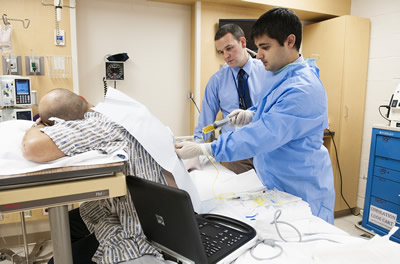
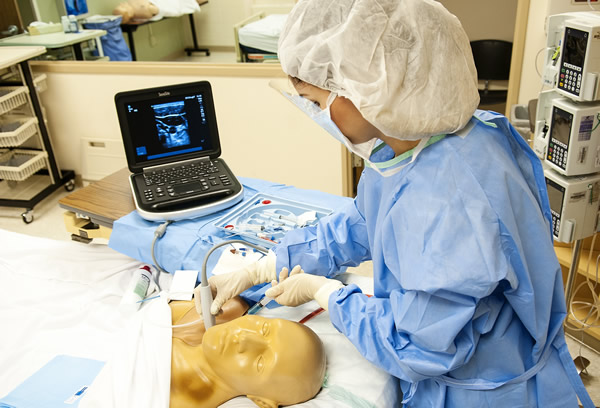
Throughout all of these steps, the resident receives feedback and assessment by the clinical procedure team staff assuring competency before moving on to the next level of procedures. Formal assessment with multimedia interactive testing tools occurs at various points during the 4 week rotation. There is significant 1-on-1 time between the resident and the procedure rotation staff necessary to adequately teach the intricacies and troubleshooting of the individual procedures.

The Internal Medicine Resident Procedure Team procedure volume has steadily grown and currently averages around 500 procedures anually. Additionally, the variety of procedures done on the team represents the breadth of internal medicine.The goal is for continued growth, balanced with ample educational and simulation training time while the resident is on the rotation.
The resident on the rotation accompanies the internal medicine bedside ultrasound team when not performing procedures. This allows the resident to work one-on-one with the one of the IMBUS faculty and increase his or her exposure to bedside ultrasound and hands-on ultrasound skill over the course of the 4 week rotation.

